



Have you ever watched a movie and found yourself staring at the screen long after it ended, as if you’d just returned from another dimension? As if your entire sense of reality has been distorted? And suddenly you find yourself wondering if you can trust anyone at all?
This You Can See Everything 2026 review examines why getting closer to the truth doesn’t necessarily mean understanding it, especially when everyone seems to have their own versions of reality.
Plot details of You Can See Everything (2026)
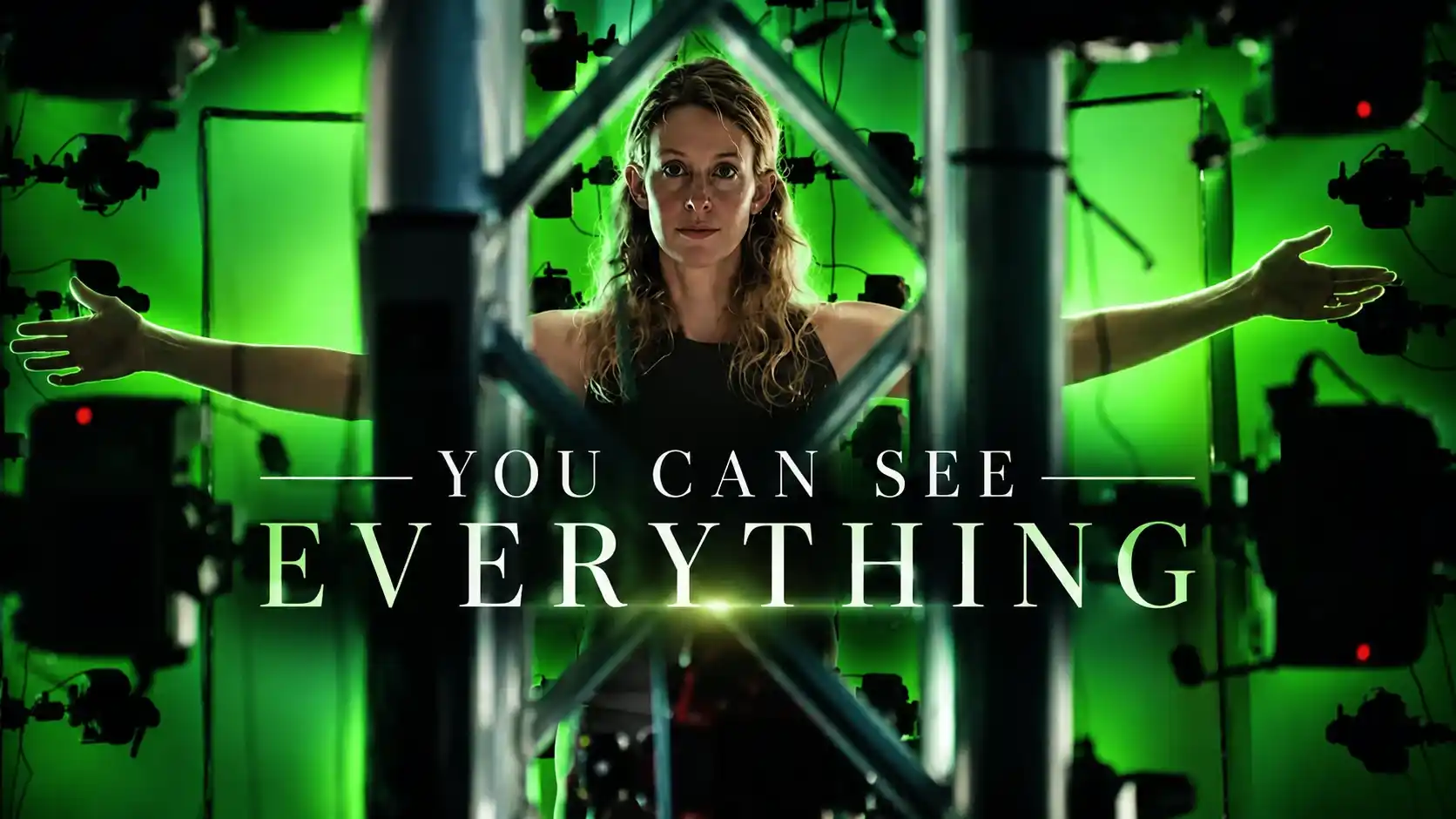
34 days before going to prison, the disgraced Theranos founder, Elizabeth Holmes, invites a film crew into her San Diego rental home to capture her final weeks of freedom. The documentary shows her partner, Billy Evans, whom the director, Nathan Fielder, captures with immense skepticism, and keeps asking the seemingly challenging couple some questions about their work and life.
See how the mystery begins in the official trailer:
Actors’ performances in You Can See Everything (2026)
I wouldn’t call this a “performance” since it is a documentary, but as Elizabeth Holmes’ presentation of herself remains perplexing, I can only assume her “acting” is brilliant. The film ends on a truly mind-boggling note with Holmes’ alleged statement, “They’re not playing me. They’re playing a character I created,” especially since she repeatedly denies having ever lied throughout the documentary. This raises several questions, as Holmes remains the most puzzling figure, largely because it’s difficult to tell whether she’s genuinely revealing herself or simply presenting another carefully constructed version of her personality. Completely impenetrable!
The same stands true for Nathan Fielder. Throughout the documentary, we watch him as a skeptical filmmaker who questions every move of Elizabeth and her partner, Billy, until the very end. Yet, we are left confounded by the realization that Nathan himself might be starstruck by Elizabeth’s almost hypnotic ability to attract people toward her, especially with that fixed gaze of hers that holds your attention for a long time. One can only imagine how difficult it must be to remain skeptical in her presence. Nathan’s conversations with Holmes become a strange battle of perceptions, where both appear determined to understand, or perhaps control, how the other is seen.
And of course, Billy Evans is no exception. Though he is openly an outrageously arrogant person and knows what and when to say, he has got the confidence to portray things in a controlling but rather unsettling way on camera. He initially seems charming and caring towards Elizabeth, but there are signs here and there that point towards his controlling nature, especially when he takes eggs from Elizabeth’s hands, trying to hide his frustration but openly manifesting an unequal dynamic between the couple.
Amanda Seyfried is equally enchanting with her portrayal of Elizabeth, as she has done it phenomenally before in The Dropout (2022). She won the Primetime Emmy Award for Outstanding Lead Actress in a Limited or Anthology Series or Movie. The difference here is that she got an opportunity to observe the real person behind the character, whereas she portrayed her previously with a dramatized script. Her fixed gaze, deep voice, and affirmative nods of the head are all small gestures that Seyfried recreated compellingly.
What do critics add to You Can See Everything 2026 review?
The critics’ consensus shows an ecstatic review of the documentary, as it says:
“Nathan Fielder’s ironclad commitment to the bit is pushed to its limit in You Can See Everything, an inscrutable Rorschach Test of Elizabeth Holmes’ psyche that’s as absorbing as it is haunting.” [Source]
Fans’ reaction
The fans have the same sentiments about the film, as they believe the film makes you question everything you know. You can’t trust anyone, as everyone in the documentary is a liar, but this is the very aspect that makes it “riveting.” Some reviews included interesting remarks, such as “dehydrate before you go” or “three hours of deep breathing…and the theater lights go up, blink back to reality, and wonder what in the world just witnessed.”
Is it worth watching?
You Can See Everything is definitely worth watching, despite being a deceiving name in itself. And this is what makes it more intriguing, even if it leaves you with more questions than answers. By the time it’s over, you might find yourself questioning everything you thought you knew about documentaries. What exactly was Nathan trying to show us about Elizabeth Holmes? Was he hiding something about their meeting in prison? Did he genuinely care about her and want audiences to see her in a positive light? Or was he simply another person who fell under her spell?
Do you know about the Hawthorne Effect? It’s the idea that people may change their behavior simply because they know they’re being watched. And that raises an interesting question about Elizabeth Holmes. Was she deliberately presenting the best version of herself because the documentary would eventually reach the public? Impression management is an even more peculiar area to explore in this regard, as we are forced to ask whether she was carefully controlling her actions, as she was aware of being watched and what the audience would see.
And when we talk about “minds of people,” this is where she wants to play with the “perception” of people, because the documentary talks about people getting Elizabeth wrong because she wasn’t able to communicate herself properly, and at one instance, in the documentary, this situation is even called “funny,” with an example of a comedy routine, “Who’s on First?”
We have seen Hollywood revisit the scandals surrounding powerful tech figures in The Social Reckoning (2026), but You Can See Everything takes a different route, putting the real Elizabeth Holmes in front of the camera and leaving audiences to question how much of her story they should believe. The astute direction and carefully controlled pacing make even the most ordinary conversations feel gripping, with each new revelation adding another layer of uncertainty.
Lance Oppenheim has already examined the uncomfortable relationship between camera, ethics, and entertainment in Primetime (2026). With this documentary, he takes that fascination even further, questioning how much truth a camera can actually capture when the subject has her own version of the story to tell. His masterful direction allows awkward silences, uncomfortable exchanges, and unexpected moments of humor to unfold naturally, keeping audiences hooked without relying on unnecessary dramatization.
What we liked
- Nathan Fielder and Lance Oppenheim’s talented direction
- The way the documentary blurs the line between reality, performance, and manipulation
- Amanda Seyfried’s compelling return
- Uncomfortable conversations, silences, and surprising moments
- The fascinating psychological battle between Fielder, Holmes, and Billy Evans
- A thought-provoking documentary that keeps audiences guessing what is real
What could be better
- Its ambiguous approach sometimes makes it difficult to understand what Fielder is trying to achieve
- The uncertainty surrounding Holmes’ intentions can become frustrating rather than intriguing
Here is a detailed breakdown of our rating for You Can See Everything (2026):
| Story/plot | 9.5/10 |
| Characters and acting | 9.5/10 |
| Direction and pacing | 10/10 |
| Visuals and cinematography | 10/10 |
| Sounstrack/score | 10/10 |
| Themes and message | 10/10 |
| Emotional impact | 9/10 |
| Creativity and originality | 9/10 |
| Rewatchability | 10/10 |
Our rating: 9.5/10
Is You Can See Everything (2026) available to stream?
A24 distributes You Can See Everything (2026) (R-rated) in theaters from October 16, 2026, onwards, and it is not available to stream at the moment.
Genre: Documentary
IMDb rating: 9.1
Rotten Tomatoes: 96 percent on the Tomatometer (critics’ score) as well as Popcornmeter (audience’s score)
Cast: Elizabeth Holmes, Nathan Fielder, Christopher Abbot, Amanda Seyfried, Lance Oppenheim, Gary Wilmes, Phillip Andre Botello
Directors: Nathan Fielder, Lance Oppenheim
Writers: Nathan Fielder, Lance Oppenheim
Producers: Nathan Fielder, Lance Oppenheim, Maggie Ambrose, Tatiana Bears, Jack Davis
Release date: October 16, 2026
Movie runtime: 2 hours 54 minutes

Passionate Entertainment Writer | Trusted Pop Culture Voice
Madiha Ali is an experienced entertainment writer with over five years of expertise in covering movies, TV shows, celebrity news, and pop culture. Her bylines appear on trusted platforms like The Rolling Tape, Screen Anarchy, High on Films, Ary News, The Express Tribune, Tea and Banter, Show Snob, CelebFeedz, Snapfeedz, Daily Planet Media, The Irish Insider, and Movie Insiderz.
She brings a personal, insightful approach to every story—whether she’s analyzing the emotional layers of a film or giving her take on trending celebrity headlines. Madiha’s writing style is known for being authentic, well-researched, and reader-focused.
When she’s not writing, she’s fully immersed in the world of entertainment—watching new releases, revisiting classics, exploring behind-the-scenes content, or reading books that fuel her creativity. Her passion for storytelling drives her work and helps her stay connected to what matters most in the industry.
Madiha believes great stories start conversations, challenge perspectives, and stay with us long after the credits roll. Through her writing, she continues to share those stories with clarity, depth, and heart.
Expertise in Entertainment Journalism
Published on Trusted Media Platforms
Audience-Focused & Original Voice
Dedicated to Quality Content