

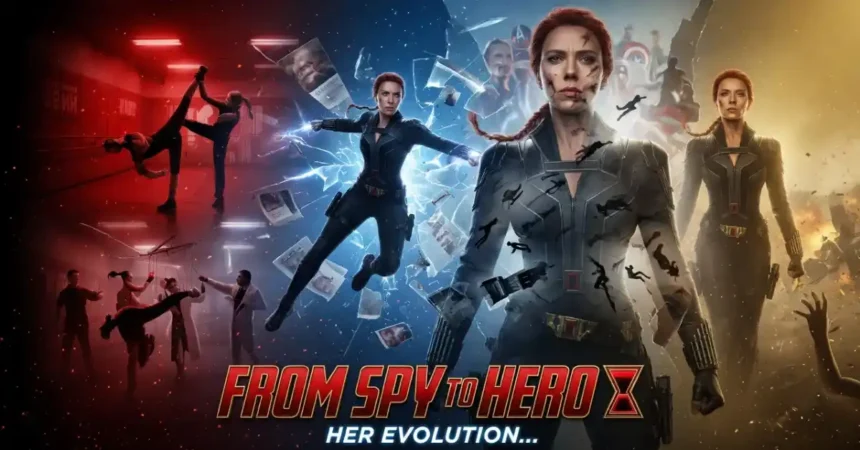
Natasha Romanoff, aka Black Widow, is an important part of Marvel’s comics, as she is one of the most enduring spies and antiheroes for more than 60 years. Her moral evolution from a Soviet villain to a hero who has constantly been struggling with her past makes her special in terms of resilience and strength as a non-powered human.
Scarlett Johansson played this special role for years, and Black Widow movies have told her story in a powerful and deeply human way, highlighting her evolution to a selfless Marvel icon. Here’s how her journey unfolds.
Black Widow Movies with an explanation of the character’s evolution
After an impressive portrayal of Zora Bennett in Jurassic World: Rebirth (2025), fans have been speculating that she might come back in Avengers: Doomsday (2026). IGN reported that she has dismissed all the rumors by saying,
“Natasha is dead. She is dead. She’s dead. Okay?” [Source]
Although Johansson was last seen as Black Widow in 2021’s standalone film, her demise was confirmed in 2019’s Avengers: Endgame, when she sacrificed herself to save Jeremy Renner’s Clint Barton, aka Hawkeye. Fans can’t get enough but speculate that maybe she is resurrected via a reset timeline or reimagined story. They haven’t stopped working on their theories. But Johansson has rejected all the claims.
Iron Man 2 (2010)
Iron Man 2 follows the story of Tony Stark (played by Robert Downey Jr.), who resists government pressure to share his armor technology. He is also seen battling with his health issues due to palladium poisoning. However, the vengeful Russian physicist is not giving up on Stark and creating his own arc reactor and the necessary alliance with a rival arms dealer.
Natasha Romanoff is introduced here as Stark’s personal assistant. Most of her role is that of a spy by S.H.I.E.L.D., but no considerable input came from her character, except for an overly sexualized persona and flaunting her fighting skills. Though she appeared highly trained and enigmatic, her presence didn’t offer much beyond a simple introduction. Of course, that is understandable, as the next films brought significant development to her character.
Marvel’s The Avengers (2012)
The film follows the recruitment efforts of the director of S.H.I.E.L.D., Nick Fury, to form a team to stop Loki from enslaving humanity. Fury assembles a team consisting of Iron Man, Captain America, The Hulk, Thor, Black Widow, and Hawkeye. All the heroes know they have to work on their clashes to prepare themselves for the battle against an alien army, the Chitauri, and Loki’s use of the Tesseract’s power.
Black Widow’s presence becomes powerful here as she becomes a key member of Earth’s heroes. Her sharp intellect and combat expertise are rightfully put to use. She becomes the emotional anchor for her team, shifting her persona from a stereotypical objectified impersonation to a proactive hero. Her psychological manipulation skills were evident in the opening scene, where she was tied to a chair and interrogated, but soon turned the tables on her captors, only to reveal who was in control.
Captain America: The Winter Soldier (2014)
The story depicts the experiences of Steve Rogers (Chris Evans), who has to fight a brainwashed villain, previously his long-lost friend, Bucky Barnes. Rogers is labeled a fugitive but is seen adjusting to modern life as an S.H.I.E.L.D. agent. The organization is infiltrated by Hydra, and with the help of Black Widow and Falcon (Anthony Mackie), he sets out to expose the conspiracy and fight the programmed Soviet assassin known as the Winter Soldier.
Black Widow shows more character depth in this story as she begins exploring her internal conflicts, loyalty, and identity. Her struggle with trust and morality reflected the larger themes of surveillance and freedom within the MCU. She is the one who drives the narrative forward by uncovering the Hydra conspiracy by navigating the gray areas and espionage. The film served as groundwork for providing tantalizing details of Black Widow’s past, possibly to give hints about her full character sketch in a standalone film.
Avengers: Age of Ultron (2015)
As the name suggests, the story is about a peacekeeping AI, Ultron, which Tony Stark created. However, his creation goes wrong when the robot thinks humanity is the biggest enemy of Earth and must be destroyed. The Avengers assemble to fight Ultron along with his drone army and also the super-powered twins Wanda Maximoff, aka Scarlet Witch, and her brother Pietro.
Here, Black Widow is a more emotionally invested team anchor who has been caught in the grip of her past, making her more vulnerable. While in the process of moving past her “red in the ledger” guilt, she has developed a romantic connection with Bruce Banner, which takes us to her personal life and identity glimpses. Through some peeks into her Red Room brutal training sessions that shaped her into an assassin, we get to know that she is emotionally scarred beneath her composed exterior, bringing us closer to her humanized version.
Captain America: Civil War (2016)
This story is complicated, as the world demands answers from the superheroes for their oversight. The Avengers and the government are not on the same page after massive collateral damage, and the government is forced to regulate the superheroes. Iron Man feels guilty, while Captain America opposes it, arguing for independence. Helmut Zemo takes advantage of this conflict and sets himself in action to destroy the team from within.
Black Widow steps into the shoes of a diplomat as she helps regain public trust after the tragic events. She puts in all her efforts to do what she thinks is right for her team as well as humanity’s stability. Although she tried her best to mediate between the two opposing sides, the disappointing results left her with no option but to support her close friend, Captain America. Her attempt to remain neutral reveals an important shift in her character: she is increasingly driven by judgment and moral reasoning.
Avengers: Infinity War (2018)
In this story, Thanos takes control as the villain, trying to collect all six Infinity Stones to wipe out half of the universe’s life. He wants to bring balance by doing so, and the Avengers, with their allies including Guardians of the Galaxy, do not want his mission to be successful. Even with the help of Titan and Wakanda, the heroes fail miserably.
Most notably, Black Widow was seen here without her famous red locks and rocked the straight blonde hair. Character-wise, she progressed beyond her personal backstory and took the role of leadership with maturity and responsibility in a collapsing world. She is no longer acting as a spy or a team member only; she is battle-tested, which means she is stronger than before. She accepts the position of a field leader and operates with discipline, decisiveness, and emotional control.
Avengers: Endgame (2019)
Every battle sees sacrifices; one was in Infinity War and the second in Endgame. Five years after Infinity War, the surviving Avengers launch a “Time Heist” to steal the Infinity Stones from the past. They successfully do so, but face the same Thanos in the final battle. This comes with Iron Man’s sacrifice and the retirement of Captain America.
Black Widow was already devastated after the events of Infinity War, which took an emotional toll on her. Though she grows into a strong leadership role, she also becomes more fearless, willing to sacrifice herself for the team she now considers her family. By the end, she reaches her emotional peak and is no longer the reserved agent from Iron Man 2, but one of the most compassionate and committed Avengers.
Black Widow (2021)
In the Age of Ultron, we get brief flashes of the Red Room training, but the Black Widow film takes us to the events happening between the next two featured films. Natasha is seen with long red hair, facing her traumatic past and redeeming herself for past sins. Other characters that make up her first family also come into view, including her adopted little sister, Yelena Bolova (a character portrayed by Florence Pugh in 2025’s Thunderbolts*).
Where just before her end in Endgame, which showed Black Widow’s selflessness and growth in a complex female-led MCU character, the Black Widow film showed the process of her individual exploration, as this long-overdue closure to her character was much needed. A major part of her character focused on global threat missions, but reclaiming her identity was a different angle pursued in this film. Her familial connections challenged her emotional barriers and helped her reframe her understanding of trust, loyalty, and belonging. She comes out of the shell of her guilt and takes active responsibility for it, showing a more mature moral evolution.

Passionate Entertainment Writer | Trusted Pop Culture Voice
Madiha Ali is an experienced entertainment writer with over five years of expertise in covering movies, TV shows, celebrity news, and pop culture. Her bylines appear on trusted platforms like The Rolling Tape, Screen Anarchy, High on Films, Ary News, The Express Tribune, Tea and Banter, Show Snob, CelebFeedz, Snapfeedz, Daily Planet Media, The Irish Insider, and Movie Insiderz.
She brings a personal, insightful approach to every story—whether she’s analyzing the emotional layers of a film or giving her take on trending celebrity headlines. Madiha’s writing style is known for being authentic, well-researched, and reader-focused.
When she’s not writing, she’s fully immersed in the world of entertainment—watching new releases, revisiting classics, exploring behind-the-scenes content, or reading books that fuel her creativity. Her passion for storytelling drives her work and helps her stay connected to what matters most in the industry.
Madiha believes great stories start conversations, challenge perspectives, and stay with us long after the credits roll. Through her writing, she continues to share those stories with clarity, depth, and heart.
Expertise in Entertainment Journalism
Published on Trusted Media Platforms
Audience-Focused & Original Voice
Dedicated to Quality Content