

Henry Cavill is an avid book reader, and much of the zeal that he brings to his roles comes from those learnings. He encapsulated the role of Geralt in The Witcher (2019 onwards) and personalized it to bring that character to life.
Similarly, Henry Cavill’s Superman movies remain an apt example of the fact that a perfect blend of strength and an acceptance of vulnerabilities is the most ‘human’ version of a superhero that resonated well with the audience.
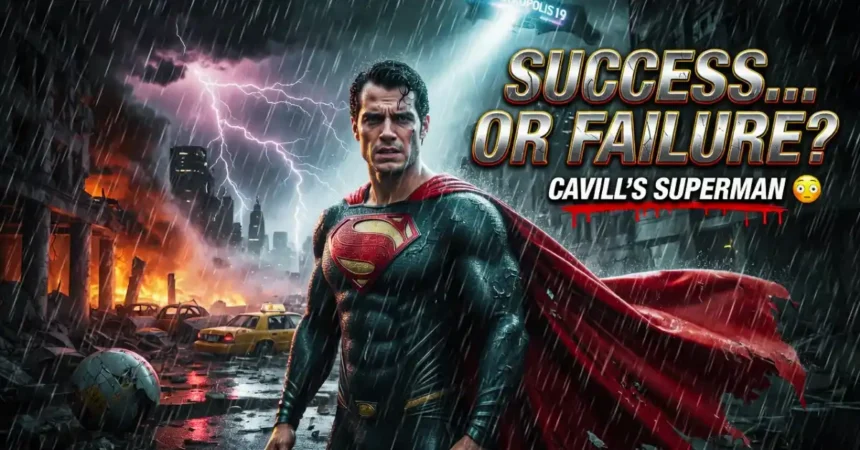
Though James Gunn and Peter Safran have moved on to a newly selected Superman for the rebooted DC Studios, people still miss Henry Cavill’s Superman. For the sake of nostalgia, Movie Insiderz has compiled a list of all Superman movies in which Henry Cavill played the titular role, along with a breakdown of their success and failure.
Henry Cavill’s Superman movies timeline: Exploring the success and failure of each film
Man of Steel (2013)
Henry Cavill debuted with his role as Superman in Man of Steel (2013) with a grittier tone of DC Comics’ one of the most classic superheroes. Directed by Zack Snyder, the film is a reimagination of Superman’s origin story as Kal-El (Henry Cavill) hides his superpower on the planet Earth, where he is raised by human parents. General Zod (Michael Shannon) wants to transform the Earth into a new Krypton, and Superman is the one who stops him.
With an IMDb rating of 7.1 and a critics’ score of 56 percent on Rotten Tomatoes, Man of Steel is considered a commercial success but divisive in terms of critical and audience reviews. Against a budget of $225,000,000, it collected $670,145,518 worldwide, per The Numbers. It could be deemed a modest Warner Bros. success, as it did not reach the billion-dollar highs as was expected from a comic hero movie otherwise.
It could be due to the fact that the film’s tone was different from the previous interpretations, which were more positive. The audience might not have been able to grasp the somber tone and excessive destruction that departed from the traditional optimism.
Batman v Superman: Dawn of Justice (2016)
Again directed by Zack Snyder, the serious tone is evident in this feature as well, since the two superheroes come face-to-face. Bruce Wayne, aka Batman, fears Superman due to his unchecked powers after the Metropolis destruction in Man of Steel. Lex Luthor finds a chance to manipulate Superman and start a brutal conflict with Superman. On the other hand, Luthor unleashes the creature Doomsday, forcing the heroes to unite against a greater threat, with the help of Wonder Woman.
Securing even lower ratings than Man of Steel, Dawn of Justice ended up with only a 28 percent critics’ score on Rotten Tomatoes, along with an IMDb rating of 6.4. Though a massive box office success in the opening week, the viewership dropped in the second week due to bad word-of-mouth, which mostly came from a confusing plot and severe CGI issues in continuous reshoots.
The film broke even but was a creative failure, as the long-term confidence in the brand was almost lost. Audiences were drawn to theaters largely due to the characters’ popularity and the promise of an epic theatrical experience.
Justice League (2017)
Brought to life by Zack Snyder once again, Bruce Wayne and Wonder Woman recruit meta-humans like Aquaman, Cyborg, and The Flash to resurrect Superman after he died in the last chapter. They want Superman’s help to fight against Steppenwolf, the ultimate antagonist of the film, whose main role is to act as a herald sent to conquer the worlds. The superhero team wants to stop the villain from terraforming Earth, which would lead to the planet’s destruction.
A slightly higher critics’ score of 37 percent and an IMDb rating of 6 weren’t enough for Henry Cavill’s Superman to reclaim its glory. It is considered both a critical and a commercial failure, and a lot of money was lost for Warner Bros. Zack Snyder stepped away from post-production due to a family tragedy, and Joss Whedon was brought in to finish the film. It contributed to the change in Snyder’s tone with forced humor.
Rushed reshoots cut the runtime to under two hours, sacrificing essential character arcs, even though the casting was widely considered spot-on. Also, the ill-famed mustache removal of Henry Cavill resulted in a somewhat distorted upper lip that cost Warner Bros. $3 million in CGI for doing so.
Zack Snyder’s Justice League (2021)
2021’s Justice League was a four-hour-long director’s cut, which was not a theatrical release. It premiered to present the director’s original vision after the 2017 version, which gathered immense criticism. The plot is the same as the previous one, except that it was divided into six parts and an epilogue. It also shed light on Cyborg’s origin, the resurrection of Superman, and the prevention of Mother Boxes (three immensely powerful supercomputers, which, if combined, create unprecedented powers that would allow the villain to terraform and destroy Earth) from uniting.
It was praised by the fans and critics alike, reflected in its IMDb rating of 7.9 and a critics’ score of 79 percent. It offered a more satisfying arc for Cavill’s Superman, though it was not a theatrical release. It was viewed as an artistic success since narrative depth and character development gave the fans the contentment that had been missing in the last part. The story appeared more cohesive, and the tone aligned with Snyder’s darker, mythic vision for the DC universe.
Cameo in Black Adam (2022)
Directed by Jaume Collet-Serra, the story followed Teth-Adam (Dwayne Johnson), who was freed from a magical prison in modern-day Khandaq. Empowered by ancient gods, he is a legendary warrior with a lifespan spanning 5,000 years. He gained his powers from a tragedy rather than a gift and wants to contain them. He does this by prompting the Justice Society, including Hawkman, Dr. Fate, Atom Smasher, and Cyclone, to intervene.
Henry Cavill made a surprise cameo in the post-credits scene, signaling his return to the DC-verse. Dwayne Johnson insisted on this cameo so that future strategy for Cavill’s Superman could be set. However, after the restructuring under Gunn and Safran, this marked his final appearance.
The film was an overall critical and creative failure, and even failed to break even at the box office. The storyline was criticized for being weak, and as an antihero narrative, it fell short of making any impression with strictly baseline ideas.
Despite being widely regarded by fans as a perfect casting choice for Superman, Henry Cavill’s Superman movies gained lower ratings from critics and proved divisive among general audiences. It was not due to his performance but rather an incongruence in creative direction. The tonal dissonance of Superman’s character was not accepted by people, as Zack Snyder’s rendition turned Superman into a “brooding,” “morose,” and moody character, which was a clear contrast with a hopeful and uplifting image of Superman.

Passionate Entertainment Writer | Trusted Pop Culture Voice
Madiha Ali is an experienced entertainment writer with over five years of expertise in covering movies, TV shows, celebrity news, and pop culture. Her bylines appear on trusted platforms like The Rolling Tape, Screen Anarchy, High on Films, Ary News, The Express Tribune, Tea and Banter, Show Snob, CelebFeedz, Snapfeedz, Daily Planet Media, The Irish Insider, and Movie Insiderz.
She brings a personal, insightful approach to every story—whether she’s analyzing the emotional layers of a film or giving her take on trending celebrity headlines. Madiha’s writing style is known for being authentic, well-researched, and reader-focused.
When she’s not writing, she’s fully immersed in the world of entertainment—watching new releases, revisiting classics, exploring behind-the-scenes content, or reading books that fuel her creativity. Her passion for storytelling drives her work and helps her stay connected to what matters most in the industry.
Madiha believes great stories start conversations, challenge perspectives, and stay with us long after the credits roll. Through her writing, she continues to share those stories with clarity, depth, and heart.
Expertise in Entertainment Journalism
Published on Trusted Media Platforms
Audience-Focused & Original Voice
Dedicated to Quality Content